Banc of California Stock Price and Value Analysis
Banc of California (NYSE:BANC) in our automated value investing analysis, with the cash flow history and price comparison below.
Key Facts
- Ticker: BANC (NYSE)
- Current price: $16.95
- Sector: Financial Services
- Industry: Banks - Regional
- Dividend yield: 2.68%
Advertisement helps keep Trendshare free for most readers.
Hold-time calculator
Estimate how long you need to hold Banc of California to reach your target.
BANC Free Cash Flow Trend
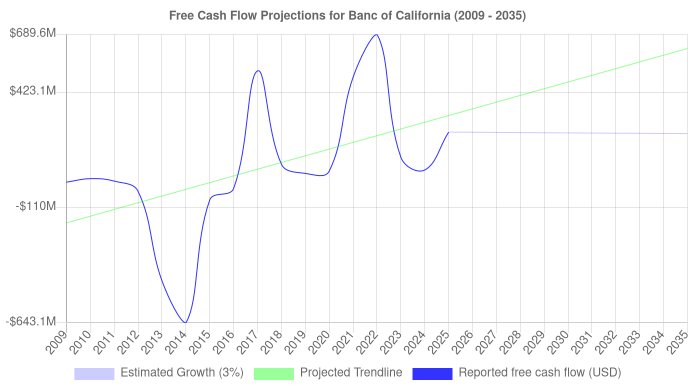
Hmm, we can't give any reliable projection for Banc of California's growth rate. The company either has too few years of historical data for us to examine, or it's in the habit of losing money.
None of this means it's a bad stock. Maybe it's new and growing quickly, or maybe it's turning things around. We can't say anything sensible about it, so we won't say it's obviously undervalued right now. Proceed at your own risk!
| Advantages | Disadvantages |
|---|---|
|
|
Inside the BANC Numbers
| BANC Price (Banc of California stock price per share) |
$16.95 | |
| PE Ratio versus Sector | 9% higher than other Financial Services stocks | |
| PE Ratio versus Industry | 60% lower than other Banks - Regional stocks | |
| Free Cash Flow Jitter | 402% | |
| Dividend Yield | 2.68% (tax impact) | Shares Shorted | 9,534,970 |
Insider Activity Summary
No open-market insider buys or sells are recorded for the last 12 months.
This stock has short interest! This means that people have shorted it.
Why does that matter? They've made a bet that price will decrease from where they bought it. Maybe there are financial problems, or maybe there's a value play.
As of the latest analysis, there are 9,534,970 shares shorted. With 156,650,163 shares available for purchase and an average trading volume over the past 10 trading days of 1,776,010, it would take at least 5.4 days for all of the short holders to cover their shorts.
Related guides: good annual rate of return · high-yield stocks · forecasting earnings growth
Free Cash Flow by Fiscal Year
How to read this: free cash flow in plain terms, free cash flow jitter.
Cash Conversion
How to read this: what free cash flow is, why earnings matter.
Over the 13 fiscal years from 2009 to 2025 with positive net income, operating cash flow totaled $1717.0 million against net income of $1742.5 million, or 0.99 times. Net income was negative in 4 of the 17 years, and those years are left out of the ratio.
In 2025, capital expenditures were $20.8 million, 8.1% of operating cash flow of $255.6 million, which leaves an estimated $234.8 million after capex. Across the 11 years with reported capex, it averaged 6.9% of operating cash flow. This uses that year's own capital expenditures, not the five-year average behind the free cash flow table, so the two can differ.
| Fiscal year | Net income (USD millions) | Operating cash flow (USD millions) | Capital expenditures (USD millions) | Operating cash flow / net income |
|---|---|---|---|---|
| 2009 | -1.0 | 7.0 | not reported | n/a |
| 2010 | 2.8 | 23.3 | not reported | 8.24 |
| 2011 | -2.7 | 13.6 | 4.9 | n/a |
| 2012 | 6.0 | -33.0 | 6.2 | -5.50 |
| 2013 | -0.1 | -435.5 | 55.0 | n/a |
| 2014 | 30.2 | -627.5 | 11.7 | -20.78 |
| 2015 | 62.1 | -43.0 | 83.3 | -0.69 |
| 2016 | 115.4 | 18.1 | 44.7 | 0.16 |
| 2017 | 57.7 | 563.0 | 15.3 | 9.76 |
| 2018 | 45.5 | 123.0 | 9.0 | 2.71 |
| 2019 | 23.8 | 80.3 | 10.5 | 3.38 |
| 2020 | 12.6 | 74.9 | 5.1 | 5.95 |
| 2021 | 607.0 | 503.0 | 17.3 | 0.83 |
| 2022 | 423.6 | 702.0 | 20.1 | 1.66 |
| 2023 | -1899.1 | 135.8 | 15.2 | n/a |
| 2024 | 126.9 | 77.4 | 13.0 | 0.61 |
| 2025 | 229.0 | 255.6 | 20.8 | 1.12 |
Where the Cash Went
How to read this: why companies buy back shares, dividend yield explained.
Over the 10 fiscal years from 2015 to 2024 with dividend or share repurchase facts, estimated free cash flow totaled $1986.2 million. That estimate uses the average of up to five years of capital expenditures, not each year's own, so it is not a reported figure.
In the 10 of those years with dividend payment facts, dividends paid totaled $481.7 million, 24.3% of the estimated free cash flow of those years. Estimated free cash flow was at least the dividends paid in 7 of those 10 years.
In 5 of the 10 years, cash spent repurchasing shares was at least 5% of that year's estimated free cash flow, and in those years it totaled $267.0 million. Smaller amounts are left out of this sentence because they can be shares withheld to pay employees' taxes on stock awards.
In 2024, dividends paid were $68.3 million, 108.0% of estimated free cash flow of $63.2 million. That was more than the estimated free cash flow of the year.
| Fiscal year | Estimated free cash flow (USD millions) | Dividends paid (USD millions) | Cash spent repurchasing shares (USD millions) | Total returned (USD millions) | Total as a percent of estimated free cash flow |
|---|---|---|---|---|---|
| 2015 | -75.2 | 17.0 | n/a | 17.0 | n/a |
| 2016 | -22.0 | 21.8 | 42.0 | 63.8 | n/a |
| 2017 | 521.0 | 25.7 | n/a | 25.7 | 4.9% |
| 2018 | 90.2 | 32.7 | 40.2 | 73.0 | 80.9% |
| 2019 | 47.7 | 15.7 | 46.4 | 62.1 | 130.3% |
| 2020 | 57.9 | 11.8 | 12.0 | 23.9 | 41.2% |
| 2021 | 491.5 | 119.4 | 93.3 | 212.7 | 43.3% |
| 2022 | 689.6 | 120.3 | 75.1 | 195.3 | 28.3% |
| 2023 | 122.1 | 48.9 | n/a | 48.9 | 40.0% |
| 2024 | 63.2 | 68.3 | n/a | 68.3 | 108.0% |
Free cash flow here is an estimate: operating cash flow less the average of up to five years of capital expenditures. Cash spent repurchasing shares can include shares withheld to pay employees' taxes on stock awards. The entry n/a means the filings gave no usable figure, not that the amount was zero. Source: the company's annual reports to the SEC.
Revenue and Cash Margin
How to read this: earnings and margins.
Revenue was $6.3 million in 2016 and $1818.8 million in 2025, a compound annual growth rate of 87.6% over 9 years. The starting revenue was under 10% of the latest, so that rate comes from a small base and says little about recent growth.
Revenue fell 3.8% from 2024 to 2025.
Our estimated free cash flow was $238.3 million in 2025, 13.1% of revenue. In 2016 the estimated margin was negative 348.5%. This estimate charges each year with the average of up to five years of capital expenditures, so it is not the free cash flow the company reported.
| Fiscal year | Revenue (USD millions) | Estimated free cash flow (USD millions) | Estimated free cash flow / revenue |
|---|---|---|---|
| 2016 | 6.3 | -22.0 | -348.5% |
| 2017 | 6.6 | 521.0 | 7931.7% |
| 2018 | 5.6 | 90.2 | 1609.9% |
| 2019 | 4.0 | 47.7 | 1201.1% |
| 2020 | 3.8 | 57.9 | 1521.3% |
| 2021 | 1352.7 | 491.5 | 36.3% |
| 2022 | 1631.3 | 689.6 | 42.3% |
| 2023 | 1522.7 | 122.1 | 8.0% |
| 2024 | 1889.8 | 63.2 | 3.3% |
| 2025 | 1818.8 | 238.3 | 13.1% |
Balance Sheet
How to read this: how debt and assets are compared, the current ratio.
In 2025, cash and equivalents were $2308.0 million against total liabilities of $31256.2 million, or 7.4% of total liabilities. Total liabilities include everything the company owes, not only borrowed money.
Total liabilities were 89.8% of total assets in 2025, compared with 84.2% in 2010, an increase of 5.6 percentage points.
Stockholders equity was $3541.3 million in 2025, compared with $136.0 million in 2010, a rise of 2503.7%.
Based on our estimated free cash flow, cash flow return on invested capital (CROIC) was 0.7% in 2025. Invested capital here is total assets less cash and current liabilities.
| Fiscal year | Total assets (USD millions) | Cash and equivalents (USD millions) | Total liabilities (USD millions) | Stockholders equity (USD millions) |
|---|---|---|---|---|
| 2010 | 861.6 | 59.1 | 725.6 | 136.0 |
| 2011 | 999.0 | 44.5 | 814.5 | 184.5 |
| 2012 | 1682.7 | 108.6 | 1493.9 | 188.8 |
| 2013 | 3627.9 | 110.1 | 3303.3 | 324.7 |
| 2014 | 5971.3 | 231.2 | 5468.0 | 503.3 |
| 2015 | 8235.6 | 156.1 | 7583.1 | 652.4 |
| 2016 | 11029.9 | 439.5 | 10049.6 | 980.2 |
| 2017 | 10327.9 | 387.7 | 9315.5 | 1012.3 |
| 2018 | 10630.1 | 391.6 | 9684.5 | 945.5 |
| 2019 | 7828.4 | 373.5 | 6921.2 | 907.2 |
| 2020 | 7877.3 | 220.8 | 4282.4 | 3595.0 |
| 2021 | 9393.7 | 228.1 | 5394.1 | 3999.6 |
| 2022 | 41228.9 | 228.9 | 37278.4 | 3950.5 |
| 2023 | 38534.1 | 5377.6 | 35143.3 | 3390.8 |
| 2024 | 33542.9 | 2502.2 | 30042.9 | 3499.9 |
| 2025 | 34797.4 | 2308.0 | 31256.2 | 3541.3 |
Price Versus Our Estimated Value
Banc of California reported positive free cash flow in 12 of the 17 fiscal years we have from its current SEC filer.
The latest three years average $141.2 million in free cash flow against $14.1 million for the earliest three, which is a sharp rise.
Year-to-year variability in free cash flow is volatile, measured at 402%.
We do not estimate a fair value for Banc of California while its free cash flow growth is not positive, so there is no value comparison here.
The dividend yield for Banc of California is 2.68%.
Our value investing guide explains how to test these numbers against the filings themselves.
Compared With Its Sector and Industry
How to read this: the price to earnings ratio.
Its trailing P/E ratio is 9% above the average for stocks in the Financial Services sector.
Its trailing P/E ratio is 60% below the average for stocks in the Banks - Regional industry.
A P/E ratio depends on trailing earnings, which one-time items can distort, so a lower P/E is not by itself evidence of value.
SEC Filer History
Every fiscal year on this page is reported by one SEC filer, CIK 1169770.
Each figure on this page comes from that filer.
Risks to This Analysis
How to read this: understanding investment risk.
- Free cash flow was negative in 5 of the 17 years we have.
- Free cash flow is volatile from year to year, so the estimates depend heavily on which years are included.
- We have no value estimate for this stock, so no price comparison is made.
- These figures are automated calculations from SEC filings and the recent price. They may contain errors, and they do not reflect lawsuits, management changes, or other events the filings do not show.
How This Page Is Made
- Latest annual report used
- Fiscal year 2025
- Price and market data last refreshed
- 2026-11-18
- Model assumptions last reviewed
- 2026-11-09
Company figures come from the annual reports (Form 10-K) that each company files with the SEC, read from the SEC EDGAR company facts data. The share price and other market data come from a market data provider.
Free cash flow here is operating cash flow minus capital spending. To keep one unusual year from swinging the result, each year is charged with the average of up to five years of capital spending, so the figure is an estimate and not the free cash flow a company reports.
The fair price is the present value of ten years of projected free cash flow plus a terminal value, discounted at 10.1 percent a year, the long-run return of US stocks, with 2.5 percent growth after year ten. The figures on this page are estimates, not advice.
This analysis covers US companies that file 10-K annual reports. Free cash flow describes banks, real estate investment trusts and funds poorly, so treat their figures with extra caution. In the cash returned and balance sheet tables, a value of zero is treated as a gap in the data, not as a real zero.
Read the filings yourself: BANC annual reports (10-K) on SEC EDGAR. To try your own growth rate, use the intrinsic value calculator on this page. Our editorial standards explain how Trendshare handles its sources and corrections.
Advertisement supports free stock analysis content.
Questions to Answer Before You Invest in BANC
Does Banc of California have a coherent story? Does it have a plan to continue to make money? Is it worth your time? Only you can decide where to go from here. Our investment guide helps you ask the right questions, including how to buy stocks. Use these research links for more information.
Worked example: BANC
This example shows how we apply the Trendshare checklist to BANC: earnings power, cash generation, valuation, and margin of safety.
We check: business quality, free cash flow, P/E, and margin of safety.
-
Step 1 — Snapshot
- Price: 16.95
- Market cap: $2.7B
- EPS: -0.32
-
Step 2 — Valuation checks
- P/E: —
- FCF yield: —
- Date checked: Nov 18, 2026
-
Step 3 — Margin of safety
- Compare price to fair value and safety price.
- Look for durable cash generation and reasonable leverage.
- Decide if it passes your personal checklist.
Most Popular Articles
What are Broker Fees (and how to pay less)?
What is Liquidity in Stocks and Financial Instruments?